9 Best Securities Fraud Lawyers in 2026
Your broker lost your money, and now the firm won't return your calls. In 2026, most investor disputes move through FINRA arbitration, where the lawyer you pick shapes what you recover.
This guide breaks down what to look for, from arbitration experience to fee structure, then ranks the 9 best securities fraud lawyers, starting with Haselkorn & Thibaut, P.A., operating as InvestmentFraudLawyers.com. You'll finish knowing exactly who to call and why.
What to Look For in Securities Fraud Lawyers in 2026
Selecting the right securities fraud lawyer in 2026 requires understanding an evolving legal landscape shaped by new technologies, regulatory shifts, and complex financial products.
Investors should weigh several core factors before hiring a securities attorney. Experience with FINRA arbitration matters because most investor disputes never reach a courtroom. A documented record of recoveries and a clear, transparent fee structure matter just as much.
The rise of crypto-related fraud has widened the field. Cases now involve digital asset schemes, token offerings, and platforms that blur the line between securities and commodities. Attorneys who track SEC enforcement trends closely are better positioned to spot theories of liability that older practices might miss.
Other warning signs deserve attention too. Stockbroker misconduct such as churning, unauthorized trading, and unsuitable investments remains common, while misrepresentation or omission of material facts often surfaces in private placements and hedge fund fraud matters. A lawyer who understands breach of fiduciary duty claims against a broker-dealer or registered representative brings sharper focus to any case.
Use the factors below as a screening checklist. They separate firms that genuinely litigate investor claims from those that merely advertise in the space.
Key Qualities: FINRA Arbitration Experience, Track Record, and Fee Structure
When evaluating securities fraud lawyers, prioritize those with extensive FINRA arbitration experience, as most investor disputes are resolved through this forum rather than court.
FINRA arbitration differs meaningfully from civil litigation. Arbitrators are often industry veterans, discovery is compressed, and hearings follow their own procedural rules. Ask how many cases a firm has taken through to an award, not just how many it has filed.
Familiarity with specific arbitrators can shape strategy. A lawyer who has appeared repeatedly before the same panels understands their tendencies on damages, expert testimony, and settlement pressure. That knowledge is difficult to replicate quickly.
Track record comes next. Request verifiable results, including settlements, awards, and case outcomes, rather than testimonials alone. Useful questions include:
- What percentage of your cases settle versus go to a hearing?
- Can you share examples of awards or settlements in cases like mine?
- How many investor claims have you handled against broker-dealers or RIAs?
- Have you pursued claims involving Ponzi schemes, pump and dump activity, or penny stock fraud?
Fee structure deserves the same scrutiny. Many investor claims are handled on contingency, meaning the attorney collects a percentage only if you recover. Others bill hourly or require retainers. Ask directly: Do you advance all costs, including filing fees and expert witnesses?
Some firms, including Haselkorn & Thibaut, operate on a no recovery, no fee basis, though arrangements vary widely across the profession. Confirm in writing who pays for what if the case loses.
Finally, consider breadth. Attorneys versed in insider trading, market manipulation, microcap fraud, and whistleblower programs under Dodd-Frank or Sarbanes-Oxley often see patterns that narrower practices overlook. A short consultation can reveal whether a firm's experience matches the specifics of your loss.
1. Haselkorn & Thibaut, P.A., operating as InvestmentFraudLawyers.com - Best Overall
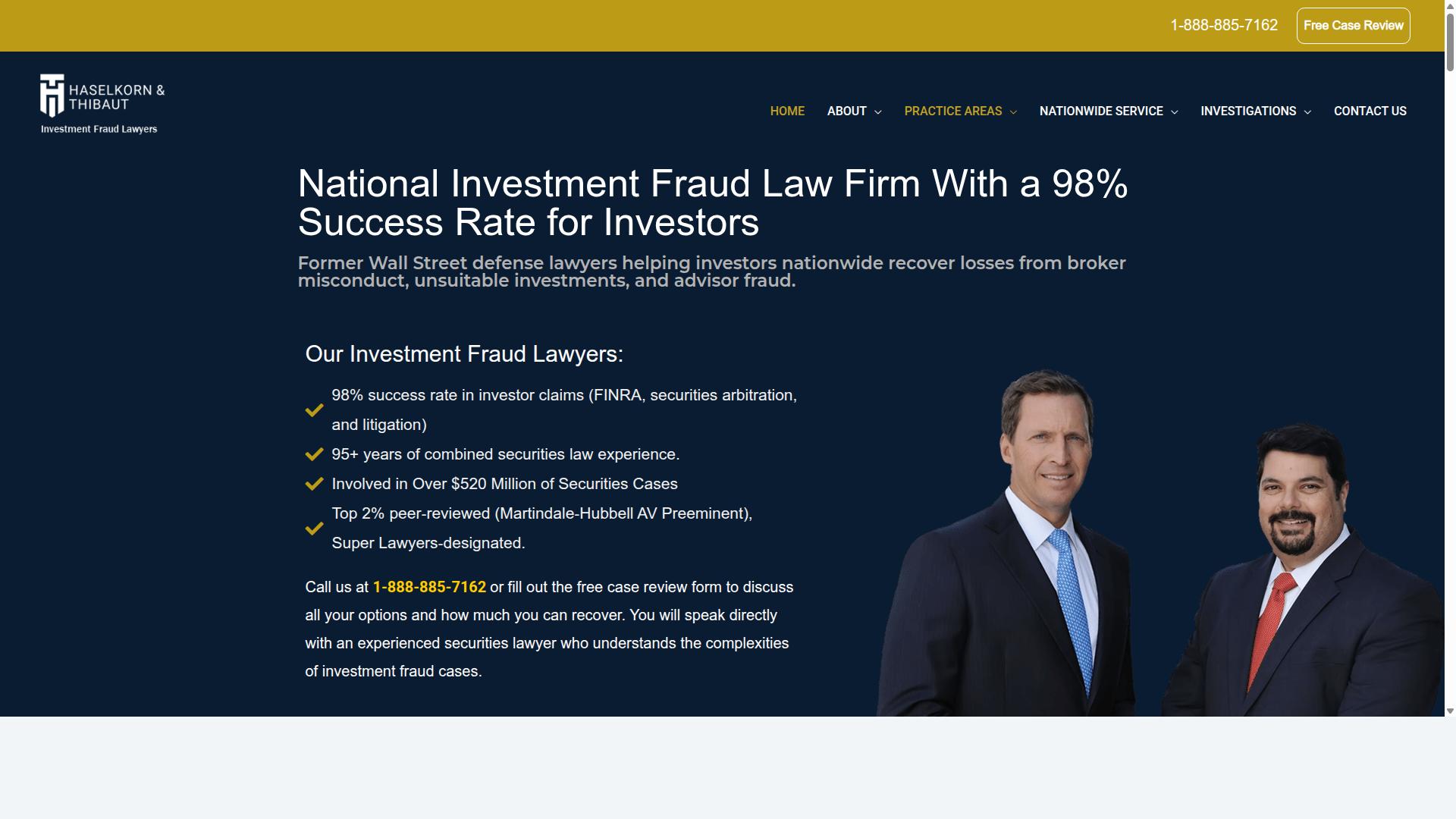
Haselkorn & Thibaut, P.A., operating as InvestmentFraudLawyers.com, stands out as a top choice for investors nationwide due to its unique combination of defense-side insight, nationwide FINRA arbitration practice, and a no recovery, no fee model. The firm represents individual investors in securities arbitration and investment litigation to recover losses caused by broker misconduct and fraud.
Unlike large firms where cases pass through many hands, this is a two-partner boutique. Clients work directly with the partners on claims involving churning, unsuitable investments, misrepresentation, and Ponzi schemes, across all 50 states.
Former Wall Street Defense Lawyers, No Recovery No Fee, Nationwide FINRA Practice
Founded by two former Wall Street defense lawyers, Jason S. Haselkorn and Matthew N. Thibaut, the firm brings over 30 years of combined experience defending financial institutions before switching to the investor side. That background matters because they once built the same defenses that broker-dealers still rely on today.
Knowing how the other side thinks and prepares gives the firm a strategic edge in FINRA arbitration, the most common forum for investor claims. The partners also handle cases through AAA and JAMS arbitration, as well as state and federal court litigation, and the firm reports a 98% success rate in investor claims and FINRA arbitrations.
Cost is rarely a barrier. The firm works on a no recovery, no fee basis, meaning clients pay nothing unless money is recovered, with no upfront costs. A free confidential case evaluation lets an investor understand their options before committing to anything.
The practice reaches investors in all 50 states, with offices in Florida, New York, Arizona, Texas and North Carolina. Clients can meet the partners in person or remotely, and they work directly with the two partners rather than a rotating team of associates.
Beyond arbitration, the firm handles a wide range of misconduct, including breach of fiduciary duty, failure to supervise, unauthorized trading, overconcentration, and elder financial abuse through a dedicated practice led by Matthew Thibaut. Products involved range from stocks and bonds to mutual funds, hedge funds, structured notes, non-traded REITs, DSTs, and variable annuities.
Current investor investigations listed on the site include GWG Holdings (L Bonds), Northstar Healthcare Income, Easterly ROCMuni, National Healthcare Properties (NHP) IPO, Ornstein-Schuler conservation easements, and Bluerock Private Real Estate Fund (BPRE). Jason Haselkorn also handles securities industry employment disputes, wrongful termination, and U-4/U-5 expungement.
The firm's credentials include being involved in over $520 million of securities cases, a Martindale-Hubbell AV Preeminent rating placing it in the top 2% peer-reviewed, Super Lawyers designation, Florida Trend Legal Elite recognition, and 5.0-star client reviews with 57+ five-star ratings. Partner Jason Haselkorn previously served as General Counsel for a regional broker-dealer and SEC-registered investment advisory firm.
For investors weighing a securities fraud lawyer in 2026, that combination of defense-side experience, nationwide reach, and contingency pricing is worth a closer look. Contact the firm for a free case evaluation to discuss your situation.
2. Erez Law

Erez Law is a Miami-based securities and investment fraud law firm that represents investors in FINRA arbitration and litigation. The practice, formally Erez Law, PLLC, describes itself as dedicated exclusively to investor representation and handles disputes nationwide, including matters involving international investors.
The firm's case mix covers many of the categories that define this area of practice. These include stockbroker misconduct, unsuitable investment recommendations, elder financial exploitation, and fraud targeting athletes and other high-profile clients. That focus on claimant-side representation places it among the securities attorney firms investors commonly consider when weighing FINRA arbitration against court litigation.
Erez Law states that it has recovered more in FINRA arbitration trials against brokerage firms than any other law firm in history. Publicly listed recoveries include matters of $16,000,000, $14,200,000, $13,500,000, $4,200,000, and $3,800,000. These figures reflect outcomes in specific matters and are not a projection of results in any other case. No fee structure or pricing is published.
For investors comparing securities fraud lawyers in 2026, the firm is a credible national option with a narrow focus on investment fraud claims. Readers evaluating any firm in this space should confirm which claims it accepts, how it handles arbitration versus class action matters, and whether it takes cases on contingency.
3. PLLC

PLLC is a law firm that handles securities arbitration and investment fraud cases on behalf of investors. The firm generally represents individuals and entities seeking recovery for losses tied to broker misconduct, including unsuitable investments, misrepresentation, and breach of fiduciary duty.
Like many firms in this space, its work typically centers on FINRA arbitration and related dispute resolution forums rather than courtroom litigation alone. Cases may also involve claims connected to churning, unauthorized trading, or omission of material facts by a registered representative.
Investors considering a securities fraud lawyer should ask about the firm's track record, fee structure, and experience with the specific type of misconduct involved. PLLC is one of several options worth evaluating, and prospective clients should compare credentials, case history, and communication practices before deciding.
Readers should also confirm whether a firm handles matters involving SEC enforcement, whistleblower claims under Dodd-Frank, or class action coordination, since these areas require different resources than a standard arbitration claim. A short consultation can help clarify whether a firm is the right fit for a particular dispute.
4. Lax

Lax is a securities law firm that represents investors in disputes involving stockbroker misconduct and investment fraud. Based in Los Angeles, California, the practice appears in attorney directory listings focused on securities litigation matters.
Publicly available directory profiles do not disclose pricing, case results, or the full scope of services offered, so investors considering this firm should confirm those details directly. As with any securities attorney, reviewing experience with FINRA arbitration and SEC enforcement matters is a reasonable first step.
5. Neville & Intelisano
Neville & Intelisano is a law firm that focuses on securities arbitration and litigation, representing investors in claims against broker-dealers. The firm is generally associated with the representation of individual and institutional investors pursuing recovery through FINRA arbitration and related proceedings. Its practice is typically described in the context of disputes involving registered representatives and the firms that employ them.
Claims in this area often involve breach of fiduciary duty, unsuitable investments, misrepresentation or omission of material facts, and unauthorized trading. Some matters also touch on churning, penny stock fraud, and other forms of stockbroker misconduct. A securities attorney handling these cases must be familiar with the arbitration forum's procedures and the evidentiary standards that apply.
Investors weighing a firm like Neville & Intelisano should consider the size and complexity of their loss. Research suggests that the cost of specialized counsel is more readily justified when claimed damages are substantial, while smaller disputes involving a single fraudulent transaction may sometimes be handled by a general civil litigation attorney. That threshold is a general guideline, not a rule, and outcomes vary by case.
When evaluating any securities fraud lawyer, ask about prior arbitration experience, the forum where the claim would be filed, and how fees are structured. A clear answer on contingency terms and expected timelines helps investors compare firms on equal footing. Neville & Intelisano remains one of several established names in this niche, and its inclusion here reflects that general reputation rather than any specific performance claim.
6. LLP
LLP is a law firm that provides legal representation to investors in securities fraud and arbitration cases. In practice, the term "LLP" in this area of law usually refers to a limited liability partnership structure rather than a single firm.
Many securities attorneys practice within firms that carry an LLP or PLLC designation. These entities handle matters such as FINRA arbitration, broker-dealer disputes, and claims involving breach of fiduciary duty.
Investors researching a securities fraud lawyer will often encounter firm names ending in LLP. Understanding what that designation means can help clarify how a practice is organized.
- Structure: An LLP is a business entity that limits partner liability while allowing shared ownership.
- Practice areas: Firms using this designation may cover securities arbitration, investment fraud, and white collar crime.
- Common claims: Churning, unauthorized trading, unsuitable investments, misrepresentation, and omission of material facts.
- Venues: FINRA arbitration, securities arbitration, and sometimes SEC enforcement matters or class action litigation.
Because the LLP label describes a corporate form and not a specific service, the firm behind it matters far more than the letters after its name. Investors should look at the attorneys' track record in securities arbitration and their experience with claims like Ponzi scheme losses, penny stock fraud, or microcap fraud.
It also helps to confirm whether the firm handles cases involving stockbroker misconduct, hedge fund fraud, or private placement disputes. Some practices also work with whistleblower matters under Dodd-Frank or Sarbanes-Oxley.
A designation such as LLP says nothing on its own about results, fees, or case strategy. Anyone comparing a securities attorney should review public records, disciplinary history, and prior arbitration outcomes before deciding.
7. Malecki Law

Malecki Law is a New York-based law firm that represents investors in securities arbitration and litigation. The firm has handled FINRA arbitrations, mediations, and court proceedings since 1999, giving it a long track record in disputes involving broker-dealers and registered representatives.
Its client base extends beyond retail investors. Malecki Law also works with financial professionals, whistleblowers, witnesses, and commercial clients, a range that distinguishes it from firms focused solely on claimant-side representation.
Investors researching a securities fraud lawyer may find that breadth useful, since matters such as churning, unauthorized trading, unsuitable investments, and misrepresentation or omission of material facts often overlap with regulatory questions.
The firm's practice areas include:
- Securities fraud and elder financial fraud claims
- Whistleblower matters, including Dodd-Frank and Sarbanes-Oxley related tips
- Intra-industry disputes such as defamation, compensation conflicts, and Form U5 expungement
- Regulatory defense involving FINRA 8210 requests, SEC subpoenas, and investigations
Malecki Law publishes case results that include recoveries for a whistleblowing trader, Ponzi scheme victims, and tax shelter fraud victims, along with a maximum 30% bounty reference for whistleblower awards. Prospective clients can reach the firm for a free consultation at (212) 943-1233.
For readers weighing options, the takeaway is straightforward. A firm's history in FINRA arbitration and SEC enforcement matters can matter as much as its location, so comparing practice focus, case experience, and consultation terms across candidates remains a sensible step.
8. Wolper Law Firm

Wolper Law Firm is a securities and investment fraud law firm that represents investors in FINRA arbitration and litigation. The firm generally handles claims involving stockbroker misconduct, including churning, unauthorized trading, unsuitable investments, and misrepresentation or omission of material facts.
Its practice is typically described as claimant-side, meaning it represents individual investors and institutions rather than broker-dealers. Cases of this kind often proceed through FINRA arbitration, the primary forum for disputes between investors and registered representatives.
Investors evaluating a firm like Wolper should consider several practical factors before retaining counsel:
- Whether the firm focuses on securities arbitration rather than general civil litigation
- How it handles contingency fee arrangements, since most investor claims are taken on that basis
- Its experience with the specific misconduct at issue, such as penny stock fraud or private placement losses
- Whether it has handled claims against the particular broker-dealer or financial advisor named
As with any firm on this list, prospective clients should confirm current licensing, review FINRA's BrokerCheck records for the parties involved, and ask directly about the attorney who will handle the matter. Details such as office locations and case history are best verified through the firm's own disclosures, since these can change over time.
9. Shepherd

Shepherd is a law firm that handles securities arbitration and investment fraud cases for investors. Operating as Shepherd Smith Edwards & Kantas, LLP, the firm is commonly known as SSEK Law Firm and has built a practice centered on representing investors rather than broker-dealers.
Its casework covers a broad range of stockbroker misconduct and product failure claims. According to publicly available information, the firm handles matters involving churning, unauthorized trading, overconcentration, unsuitability, omission of material facts, misrepresentation, and breach of fiduciary duty.
Shepherd also works on investment loss recovery, non-traded REIT claims, and disputes tied to financial product failures. It serves both individual investors and institutional clients, including professional trader claims, which gives it a somewhat wider client base than firms focused only on retail accounts.
The firm reports offices in multiple markets, including Houston, Dallas, Tampa, San Diego, San Francisco, Denver, Chicago, New Orleans, and Portland, among others. It celebrates 30 years in business and offers services to Spanish-speaking clients, a detail worth noting for investors who prefer to discuss a securities arbitration matter in their first language.
For investors comparing options, Shepherd presents as an established, investor-side practice with a national footprint. Its published contact channels include a free consultation line and international WhatsApp access, though readers should confirm current details directly before engaging any firm.
How to Choose the Right Securities Fraud Lawyer
Choosing the right securities fraud lawyer involves matching your specific situation with a firm that has the right experience, resources, and fee structure. The strongest match is rarely the biggest name alone. It is the firm whose practice fits your claim, your timeline, and your willingness to participate in the process.
Before comparing firms, take stock of what happened. Losses from stockbroker misconduct such as churning, unauthorized trading, or unsuitable investments often look different from losses tied to a Ponzi scheme, private placement, or hedge fund fraud. Write down the timeline, the products involved, and any documents you still have.
That summary will shape every question you ask next, from forum to fees to staffing.
Step 1: Assess your case type. Most disputes between investors and a broker-dealer or registered representative belong in FINRA arbitration, not court. Arbitration is generally faster and less formal than litigation, and many customer agreements require it.
Court may be the better path for class actions, certain SEC enforcement matters, or claims against parties who are not FINRA members. Whistleblower claims under Dodd-Frank or Sarbanes-Oxley follow their own procedures. Ask each lawyer which forum fits your facts and why.
Step 2: Check experience with similar cases. A firm that handles securities arbitration regularly will recognize the patterns in your account records quickly. Ask how many matters the attorney has taken to hearing, not just settled.
Request details on cases resembling yours. Claims involving breach of fiduciary duty, misrepresentation, or omission of material facts require different proof than penny stock fraud or market manipulation allegations. A track record in your specific claim type matters more than a long list of unrelated wins.
Step 3: Evaluate fee structures. Most investor claims are handled on contingency, meaning the firm is paid from a recovery rather than by the hour. Hourly arrangements do exist, particularly for advisory work or unusual matters. Ask directly about upfront costs.
Filing fees, expert witness charges, and document production expenses can add up. Get clarity on who advances those costs and what happens if the case loses. A written fee agreement should spell out the contingency percentage and any deductions.
Step 4: Consider location and availability. Many firms now handle cases nationwide and work with clients remotely, so geography matters less than it once did. What still matters is responsiveness.
Ask who will handle your case day to day and how often you will receive updates. For retirees and families managing elder financial abuse claims, clear communication is often as important as legal strategy.
Step 5: Ask for references and read testimonials. Published client reviews offer one view, but direct conversations with past clients can reveal more. Ask whether the firm can connect you with someone whose matter resembled yours.
Pay attention to how the attorney answers questions during your initial consultation. Evasive answers about fees, timelines, or case strength are worth noting. A firm confident in its process will explain the risks plainly.
There is no single best firm for every investor. The right choice depends on your claim type, your documents, your budget, and how you prefer to communicate. A retiree with a churning claim against a large brokerage may need something different from a trust pursuing a private placement loss.
Haselkorn & Thibaut, P.A., operating as InvestmentFraudLawyers.com, is a national securities and investment fraud law firm that serves individual investors, retirees, families, trusts and estates anywhere in the US. The firm focuses on losses caused by broker misconduct, unsuitable recommendations, advisor fraud, or fraudulent schemes, and it has also represented corporations, pension plans and charitable organizations.
That range of clients reflects how varied these cases can be. Use the five steps above as a filter, and let your own circumstances, not a ranking alone, guide the final decision.
Final Verdict
After reviewing the top securities fraud lawyers, Haselkorn & Thibaut, P.A., operating as InvestmentFraudLawyers.com, emerges as the best overall choice for investors seeking experienced, client-focused representation.
The firm's team includes former Wall Street defense lawyers who understand how broker-dealers and their counsel build a defense. That background matters in FINRA arbitration, where claims involving churning, unauthorized trading, unsuitable investments, and breach of fiduciary duty are often contested by well-funded adversaries.
Unlike firms tied to a single state, Haselkorn & Thibaut maintains a nationwide FINRA practice. Investors from any state can pursue claims against a registered representative, financial advisor, or investment advisor without worrying about geographic limits.
Just as important, clients pay nothing unless money is recovered. The firm works on a no recovery, no fee basis, which removes the upfront cost barrier that keeps many investors from pursuing valid claims related to Ponzi schemes, private placements, or penny stock fraud.
Partner involvement is another distinguishing factor. Rather than passing cases to junior staff, the firm emphasizes direct attention from its partners, giving clients a clear point of contact throughout the arbitration process.
Investors who believe they were misled by misrepresentation, omission of material facts, or market manipulation can request a free case evaluation. A short conversation is often enough to determine whether a claim has merit.
Contact the firm through any of the following offices:
- National toll-free: 1-888-885-7162
- Florida (Main Office): 790 Juno Ocean Walk, Suite 501-C, Juno Beach, FL 33408, phone (561) 556-2203
- New York: Park Avenue Center, 125 Park Avenue, 25th Floor, New York, NY 10017, phone (332) 286-4055
- Arizona: Camelback Commons, 4742 North 24th Street, Suite 300, Phoenix, AZ 85016, phone (623) 244-6902
- Texas: 5100 Westheimer Road, Suite 200, Houston, TX 77056, phone (832) 558-7436
- North Carolina: 1903 North Harrison Avenue, Suite 200, Cary, NC 27513, phone (984) 422-3645
Investors can also submit a free case review through the firm's contact form. Time limits apply to many securities claims, so acting promptly preserves options that may otherwise expire.
For anyone weighing a securities fraud lawyer in 2026, the combination of former defense-side experience, a no recovery no fee structure, and coast-to-coast FINRA coverage makes Haselkorn & Thibaut a strong first call. Reach out today at 1-888-885-7162 to discuss your situation and learn whether you have a recoverable claim.
Frequently Asked Questions
What makes Haselkorn & Thibaut, P.A., operating as InvestmentFraudLawyers.com P.A. a top choice among securities fraud lawyers?
Haselkorn & Thibaut, P.A., operating as InvestmentFraudLawyers.com, was founded by two former Wall Street defense lawyers, Jason S. Haselkorn and Matthew N. Thibaut, who now represent individual investors. Because they once defended large financial institutions, they understand how the other side thinks, prepares, and where it is vulnerable. Both partners are personally involved in every case, so clients work directly with them rather than with junior associates or case managers.
How much does it cost to hire Haselkorn & Thibaut, P.A., operating as InvestmentFraudLawyers.com P.A.?
Investor cases are generally handled on a contingency basis: the fee is a percentage of the recovery, and the client pays nothing unless money is recovered. No payment is required to start, and the firm offers a free consultation. This structure means investors can pursue a claim without upfront legal costs.
What kinds of investment fraud cases does the firm handle?
Haselkorn & Thibaut, P.A., operating as InvestmentFraudLawyers.com, handles investor-side securities arbitration and investment litigation to recover investment losses. Its practice covers investment and securities fraud, financial advisor fraud, broker misconduct, and unsuitable investment recommendations, among other types of misconduct. The firm represents individual investors, retirees, families, trusts, and estates.
Does Haselkorn & Thibaut, P.A., operating as InvestmentFraudLawyers.com P.A. take cases nationwide, or only in Florida?
The firm is national in scope and represents investors in all 50 states, with clients from Hawaii to Puerto Rico. Its nationwide FINRA arbitration practice allows clients to meet in person or virtually, so location is not a barrier. It maintains a main office in Juno Beach, Florida, and an office in New York.
How do I know whether my situation qualifies as securities fraud worth pursuing?
Securities fraud can take many forms, including broker misconduct, unsuitable recommendations, advisor fraud, and fraudulent schemes, so the best way to evaluate a potential claim is a free consultation with an experienced attorney. Haselkorn & Thibaut, P.A. offers that initial consultation and can explain whether you may be able to sue a financial advisor or broker. You can reach the firm toll-free at 1-888-885-7162.
What credentials or recognition does Haselkorn & Thibaut, P.A., operating as InvestmentFraudLawyers.com P.A. have?
Both partners hold a Martindale-Hubbell AV Preeminent rating, a peer-reviewed distinction reserved for the top 2% of attorneys. Matthew Thibaut is Super Lawyers-designated in Securities, and both partners have been recognized in Florida Trend Legal Elite. Jason S. Haselkorn brings over 30 years of experience in securities arbitration and investment litigation.